New work from the Shell scenarios team, released on January 15th, brings a useful update to the Archipelagos scenario, reflecting on the possibility of a world that turns more towards national security concerns and self-interest and away from multilateralism, the free but legal movement of people and unhindered global trade in goods and services. With a temperature outcome around 2.5°C in 2100 in Archipelagos, the world will likely pass through 2°C by the 2060s, with implications for governments, people and potentially geopolitical stability.
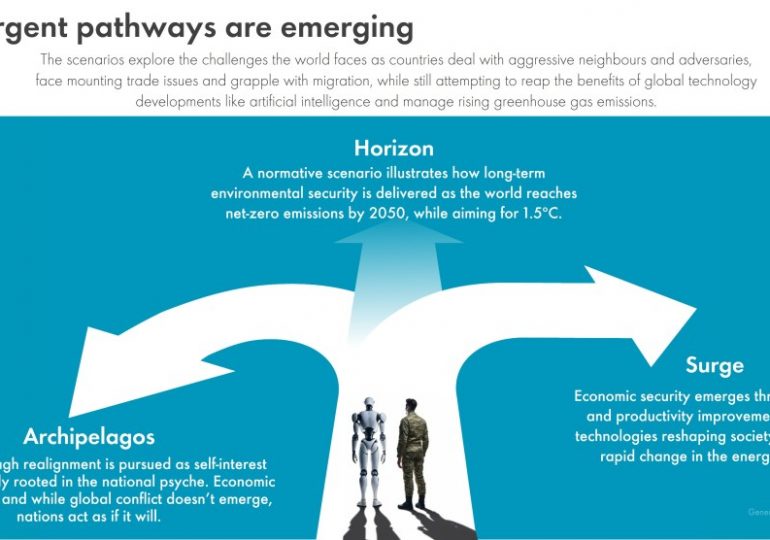
As the security mindset dominates and the global competitive landscape becomes more intense, national interests are taking precedence within political agendas. The world is entering a period of apparent polycrisis, characterised by a seemingly intractable and tangled web of problems that are not just simultaneous but also mutually reinforcing.The concerns are multiple: insipid economic growth, balancing trade with other countries, AI technologies that provide additional advantage to already advanced economies, growing militarism from traditional adversaries, and increasing climate pressures. The latter are seen through the lens of extreme weather events and legal actions around the world. We have imagined three scenarios that play out in different ways: Archipelagos, Surge and Horizon.
The Archipelagos scenario sees a world that reacts to the pressures of regional conflicts, increasing migration across multiple borders and uneven global trade patterns. Concerns mount over trade, reliable allies, a new superpower, resource availability, and the environment. In a world of uncertain and confusing signals, these concerns lead to both domestic prioritisation of key resources and new global alignments. Countries act as if global conflict is imminent, yet the scenario has no such outcome. The underlying driver within the scenario is a global realignment of influence.
In Surge, an era of robust economic growth is ushered in by AI technologies that are welcomed and not overly challenged, with economic growth and AI infrastructure driving up energy demand. The geopolitical landscape offers a spur for change as China and the USA compete for AI dominance. Surge leads to a new technocratic era, with technologies such as small modular nuclear reactors being rolled out.
Horizon takes a normative approach aimed at a world that achieves two key things: net zero emissions by 2050 and global warming limited to 1.5°C by the end of the century.
Each scenario features a unique global growth trajectory. Horizon is a normative middle case, with global economic growth between 2.5% and 3% for the balance of the 2020s and just below 2% through to 2100. In Archipelagos, trade tensions and global decoupling result in a low-growth scenario, with the world economy smaller by approximately 8% in 2050 than in Horizon. Surge is built on the highest growth assumptions, with a boost in productivity emerging from deeper use of AI technologies in global supply chains. New goods and services also emerge, further boosting growth. The annual average differences in global GDP through to 2050 are shown below.
Archipelagos sees a shift towards domestic resources and opportunism in trade, both of which tend to favour fossil fuel use, with coal demand proving to be resilient into the 2030s, but not beyond 2035. Given the weaker global economy, increased military spending and critical mineral supply mired in trade disputes, the energy transition loses some pace. Technology pathways such as direct air capture become nearer-term casualties, and growth in carbon capture and storage, other than for certain industries, is non-existent. The prospect of a global temperature outcome well below 2°C (versus 1850–1900) vanishes. Net zero emissions becomes a 22nd-century goal, however, global CO2 emissions do begin a slow trend downwards from the mid-2030s.
In Surge, the private sector takes the lead on energy and economic growth as AI technologies reshape the global economy. Surge sees both higher oil and gas demand in the shorter term and higher energy demand overall as economic growth picks up. Although new energy infrastructure appears rapidly, demand is such that existing energy production and systems are retained for longer. The private sector plays a large role in shaping the energy system through modular component production of energy infrastructure, rapid conversion of manufacturing to electrification and a late but important trend in managing CO2 emissions. Net zero emissions are achieved in 2080.
The consequences of delayed mitigation in Archipelagos is that global surface temperature continues to rise and 2°C years become the norm in the late 2040s. With global CO2 emissions still over 35 Gt per year in 2045, the pressure on governments grows. By 2050, the incidence of extreme weather events has become the one that most challenges governments in terms of response. A drop in outdoor labour productivity and some limits being placed on certain public events contribute to public concern. While the global response is weak, eventually the sheer scale of technological change drives emissions down and net zero CO2 is reached in the first half of the 22nd century. In 2100, the global average surface temperature rise is around 2.5°C.
But in Surge, a richer world is more attuned to environmental needs, which in turn prompts government policy development. While governments are instrumental in seeding technology development and early-stage demonstration, Surge is a scenario in which commercial interests in the energy transition are at the forefront. Several large technology companies build their own energy infrastructure production facilities, mimicking the gigafactory model developed by Tesla in the 2010s. They also seek to manage their growing carbon footprints through the use of direct air capture of CO2. The transition accelerates rapidly as a result. Global net zero CO2 emissions are achieved in 2080, and by 2100 the global average surface temperature rise has been limited to 2°C.
As is the case for Surge and Archipelagos, Horizon overshoots 1.5°C, but it quickly reaches a plateau at around 1.7°C as the scenario design achieves net zero CO2 emissions in 2050. With a large-scale carbon removal industry growing as the century progresses and land management goals achieved, the global average surface temperature rise is well below 1.5°C in 2100 and falling.
The energy transition is nearing a tipping point; the questions at hand are not whether society can reach net zero CO2 emissions or whether society is able to limit surface temperature warming, but how soon net zero emissions will be realised and where the eventual temperature plateau might be.
Horizon presents a reference case for meeting the goal of the Paris Agreement, with an important emphasis on the need for carbon management and the technologies and practices required. Surge illustrates that, even in a period of higher economic growth with increased access to energy services throughout the world, a plausible outcome sees warming limited to 2°C by 2100.
But Archipelagos, with its tensions, trade friction and focus on more immediate security issues, offers a warning. While a temperature outcome in 2100 around or even below 2°C above that in 1850–1900 is entirely possible, given where the world is today, it cannot be taken for granted. A world beset by restrictions, be they trade-based, related to the legal movement of people or the result of regional conflict, will turn to what it knows best and is immediately available. For energy supply, this may mean a much longer period of high coal use, along with increased use of oil and natural gas. The consequence is a world that is warmer by around 2.5°C in 2100, rather than one that is below 2°C compared to the 1850–1900 temperature baseline.
Note: Shell Scenarios are not predictions or expectations of what will happen, or what will probably happen. They are not expressions of Shell’s strategy, and they are not Shell’s business plan; they are one of the many inputs used by Shell to stretch thinking whilst making decisions. Read more in the Definitions and Cautionary note. Scenarios are informed by data, constructed using models and contain insights from leading experts in the relevant fields. Ultimately, for all readers, scenarios are intended as an aid to making better decisions. They stretch minds, broaden horizons and explore assumptions.
Leave a comment