
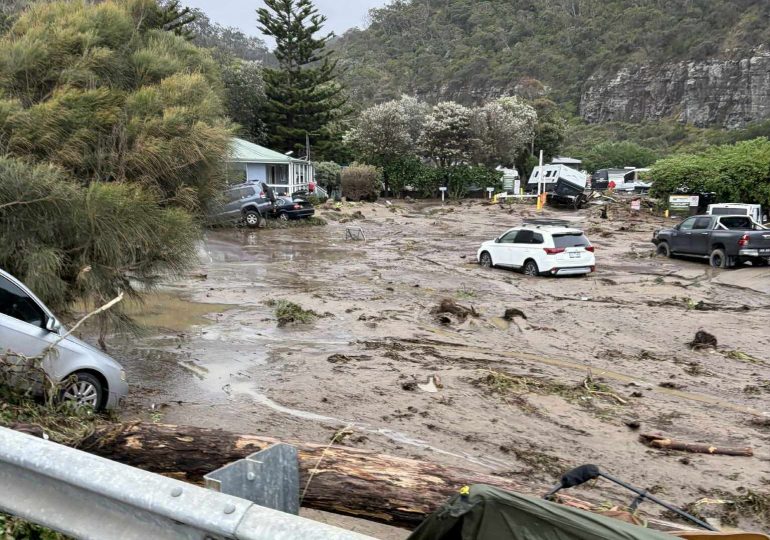
In mid January 2026, Australians watched in disbelief as an extreme downpour and violent flash flood swept cars on Victoria’s Great Ocean Road into the sea. Just days earlier, the state was in the grip of catastrophic fire conditions and the most dangerous heatwave since the infamous Black Summer of 2019-20. Cut to this week, and Victoria was again in the grip of an extreme heatwave, this one even more intense than the last.
These wild swings between weather extremes – between hot and dry to heavy rains and back again – have become all too familiar to Australians and to vulnerable communities around the world.
So what is driving this new world of violent weather extremes?
Sometimes climate science can seem fiendishly complex. But in essence things are very simple. By burning coal, oil and gas we have thickened up the blanket of heat trapping gases in our atmosphere, meaning that today our atmosphere is not only hotter, but also wetter and packing more energy.
It means that heatwaves are hotter, longer and more frequent, rainfall is more intense, and fire seasons are longer and more dangerous. Moreover, with more energy to fuel powerful storms, and the ability of our warmer atmosphere to soak up more moisture, the swing from one extreme to another has become more rapid and intense.
The past is no longer a guide for the future
The change in the background conditions driving our weather means that past weather patterns are no longer a good guide for the present. We are seeing extreme events unfold in places and at times where they never have before, at least not in living memory, meaning communities are more likely to be caught off guard. Cyclones are tracking further south, large wildfires are happening way outside of the usual season, shifting rainfall patterns are wreaking havoc with food production.
From Melbourne to Mozambique
The term climate whiplash emerged during our 2023-24 summer, when an early and ferocious fire season, driven by an El Niño pattern, gave way unexpectedly to record breaking rains. A deadly Queensland blaze in October 2023 destroyed more homes in that state than the infamous Black Summer fires did. Just weeks later, nearby weather stations registered their highest November rainfall on record. Down south, early and highly destructive fires in Gippsland, Victoria were followed almost immediately by extreme rainfall and flash flooding.
Parts of Victoria, Australia just suffered some of its worst bushfires since the Black Summer fires of 2019–20. Over 400,000 hectares are estimated to have burnt so far, an area more than five times larger than Singapore. Compounding this, Victoria is the most cleared state in Australia with only 3 percent of its native forest remaining. This makes it more difficult for animals to find suitable habitat outside of burnt areas in a fragmented landscape as they recover. © Paul Hilton / Earth Tree Imag
For many, this has come to epitomise the lived experience of climate change. And not just in Australia. On the east coast of the US, 2025 saw many communities face multiple spells of dangerous heat and humidity. Today, many of those same communities are gripped by a deadly winter storm and extreme low temperatures.
On the west coast, in California, years of severe drought were followed by exceptionally wet winters in 2022-23 and 2023-24, leading to explosive growth of vegetation. When this record wet period was followed by California’s hottest summer on record and a record-dry start to 2025, the conditions were set for the horrific LA fires.
Firefighters battle the Eaton Fire on January 8, 2025 in Altadena, California.. Powerful Santa Ana winds pushed the fire across more than 10,000 acres in less than 24 hours, destroying potentially hundreds of homes and killing five people so far. At least 1,000 structures have burned and 70,000 people are forced from their homes in the Los Angeles area as multiple dangerous wildfires continue to erupt. © David McNew / Greenpeace
On the other side of the world, in Mozambique, a prolonged dry period in 2024 and 2025 saw the country face significant food insecurity due to crop failure. This month, Mozambique is tragically facing a severe humanitarian situation due to extreme downpours and catastrophic flooding. Over a hundred people have died, and close to a million affected.
Adding fuel to the fire
Put simply, climate change, driven by the burning of coal, oil and gas, is catapulting vulnerable communities from one catastrophe to another. Hit by a succession of compounding disasters, with little or no time to recover, many are seeing their resilience pushed beyond its limits. The toll on our mental health has been profound.
The first duty of governments is to keep our communities safe. But right now, many are doing exactly the opposite. In Australia, our State and Federal Governments continue to enable the dangerous expansion of fossil fuel production. In December 2025, the Victorian Government, alongside Federal authorities, opened new areas for gas exploration in the Otway Basin, off the Victorian coast.
Aerial documentation of the Barracouta gas platform in the Gippsland Basin, about 23 km off Victoria’s east coast. It is owned and operated by Esso Australia as part of the long‑running Bass Strait joint venture with BHP/Woodside and linked by pipeline to onshore processing at Longford. Just to the west, Kerry Stokes’ Seven Group Holdings controls the nearby Longtom gas field, where the offshore regulator NOPSEMA has ordered the company to fix a gas well that has been leaking pure methane into the air for two years. As production in Gippsland winds down, new environmental risks are emerging.
The Federal and State government in Victoria have recently opened a massive new area for offshore gas exploration, and a number of gas corporations are currently drilling for new gas off the iconic coast risking coastal communities and the environment.
Meanwhile, parts of Victoria, Australia suffer some of its worst bushfires since the Black Summer fires of 2019–20. Over 400,000 hectares are estimated to have burnt so far, an area more than five times larger than Singapore. © Greenpeace / Michaela Skovran
Every new fossil fuel project increases the future risks for communities in Australia, the Pacific and around the world.
You can speak out against this climate recklessness by adding your name to Greenpeace’s submission to the Federal Government, urging them to protect our oceans and climate by abandoning plans for any further gas exploration in the Otway Basin.
Time for a fair, fast fossil fuel phase out
2026 will be a defining year for the world’s transition away from fossil fuels.
Pacific Island countries have been working for many years to spearhead a global phase-out of coal oil and gas. In a few short weeks, Vanuatu and Tuvalu will be among dozens of countries gathering in the coal port Santa Martha for the First International Conference on the Just Transition Away from Fossil Fuel, a powerful new initiative led by the Government of Colombia.
Meanwhile, as Australia prepares to take on the role of President of Negotiations for COP31, we have the responsibility to lead. Now more than ever.
The science is unequivocal: we must transition away from fossil fuels at emergency speed, while doing far more to support our communities with adapting to this new era of climate whiplash.
The future is ours to choose. Get involved.
Leave a comment