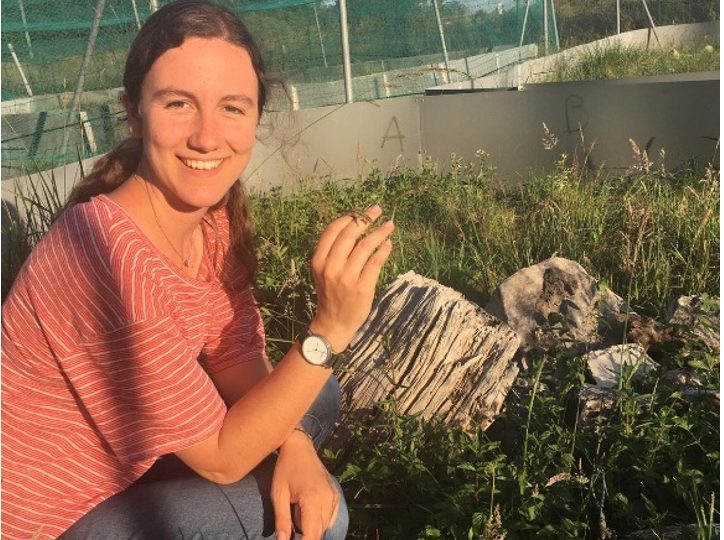
Ever wondered if thirsty lizards can still sense danger? In this week’s Behind the Paper blog post, we’ve got an answer! From their paper: “Sensing danger: energetic and hydric costs of chemoreception in a lizard”, author Chloé Chabaud shares her fascinating work exploring chemoreception in Zootoca vivipara. She found that tongue flicking in lizards is dependent on hydration levels and the more dehydrated the lizard, the less effective its chemoreceptive capabilities. Beyond her research, Chloé remains steadfast in increasing awareness and support for climate change science. You can keep updated on her and her team’s work through her socials: @chabaudchloe.bsky.social
Click here for the French Translation
1. About the Paper
This paper is about a key sense that reptiles rely on for many vital functions, such as finding prey, locating mates, and avoiding predators: chemoreception! This sense sits somewhere between smell and taste—lizards and snakes use their forked tongue to sample chemical cues from the environment (a behavior called tongue flick), and these cues help them decide what to do next. With this paper, we wanted to know what the cost of using this sense really is. Does using chemoreception require a lot of energy? And does repeatedly opening the mouth and extruding the tongue contribute to evaporative water loss, especially in dry environments?
To explore this, I worked with a small, widespread lizard found in France and across Europe: Zootoca vivipara. First, I used physiological measurements to see how much the metabolic rate and water loss changed when lizards increased their tongue-flicking in response to predator scents. Then, I tested the other side of the story: what happens when lizards are already dehydrated? By exposing dehydrated lizards to predator odours, I measured whether water deprivation affected their behaviour and their ability to discriminate scents.
We found that chemoreception — and specifically intense tongue flicking — increased both energy use and evaporative water loss. As a result, dehydrated lizards flicked their tongues less often and struggled to distinguish predator scents from harmless odours. This suggests that when water is scarce, lizards may not sense danger as effectively. These limitations could have broader consequences in nature, especially as droughts become more common with climate change, and because many other taxa use a similar sense to detect prey or predators, such as insects.
2. About the Research
For this project, we had a few challenges to solve before we could collect any data. First, we needed to capture lizards. We were lucky to work at an amazing research station, the CEREEP–Ecotron Ile-de-France, which has outdoor enclosures containing long-term monitored populations of this species. Once the animals were collected, the real technical work began. Measuring metabolic rate and evaporative water loss required an open-flow respirometry setup—a system full of tubing, sensors, and connectors that always reminds me of the marble circuits I used to build as a child. Setting up the video recordings was another challenge: we needed to start the camera without the lizard seeing us, so that our presence wouldn’t influence its behaviour.
In the second part of the project, recording the behaviour of dehydrated lizards came with an extra complication: we needed fresh snake scent every day. That meant catching live snakes around the research station, a task made much easier thanks to the help of the students and technicians working there.
3. About the Author
I am currently a postdoctoral researcher, but this project was carried out during my PhD, when I studied how water balance influences trophic interactions in the common lizard. My next project will focus on controlled ecosystems to understand how temperature changes alter species interactions and ecosystem functioning. I am especially excited to begin working with the terrestrial Metatron at the SETE station, which will allow me to study these processes in a highly integrative way.
Like many researchers in my field, I’ve noticed that pursuing experimental ecology has become increasingly difficult. Public research in Europe is chronically underfunded, and governments consistently fail to consider scientific research a priority, even though climate change is one of the most urgent global threats we face. It is frustrating to see how little long-term support is given to the very work needed to understand and mitigate these impacts. But I believe we need to stay persistent and keep advocating for the value of ecological research.
Leave a comment