
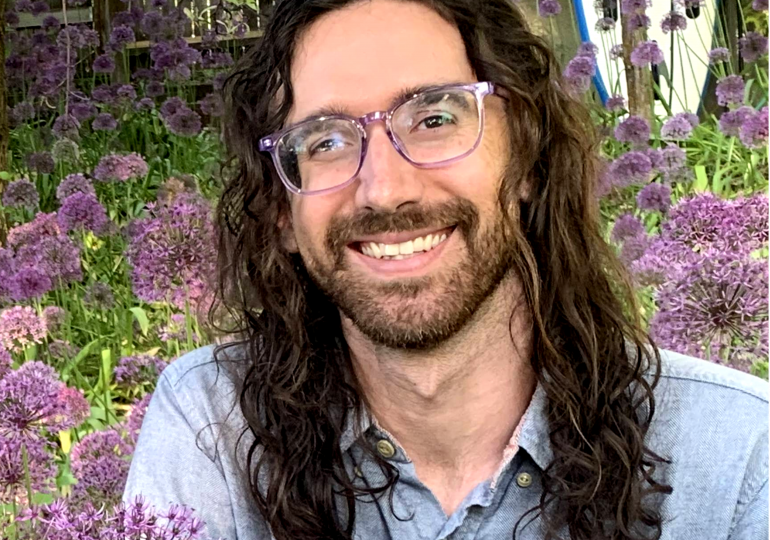
2025 HALDANE PRIZE SHORTLIST: Michael Stemkovski discusses his paper “Ecological acclimation: A framework to integrate fast and slow responses to climate change“, which has been shortlisted for Functional Ecology’s 2025 Haldane Prize for Early Career Researchers.
About the paper
Our paper presents “Ecological Acclimation” as a new conceptual framework to synthesize the various ways by which ecosystems adjust to climate change. The author team intentionally included physiologists, ecosystem modellers, evolutionary biologists, community ecologists, paleoecologists, and biogeochemists to develop our broad synthesis. We argue that processes including physiological acclimation, phenological shifts, community compositional turnover, and evolutionary adaptation operate due to disequilibrium with the climate, and that they work to reduced disequilibrium over time.
We were intrigued to find that the diversity of ecological acclimation “timescales” across processes helps explain why ecological responses climate change shift over time: observed changes – such as those from global change experiments – initially reflect the action of fast acclimation processes, but later shift due to the transient dynamics of slower acclimation processes.
We focused on providing actionable next steps that stem from our theoretical framework. We think that climate change ecology research should focus on quantifying two key parameters across various systems: the timescales of ecological acclimation, and the strength of the effect of disequilibrium on ecosystem functions.
Our team included researchers from natural resource management agencies to identify the management implications of the Ecological Acclimation framework. Decisions about whether and how to resist, accept, or direct ecological transformations can be informed by quantifying the timescales of ecological acclimation and the effects of disequilibrium on ecosystem services.
About the author
My appreciation for ecology began as a child in Belarus, when my family would forage for mushrooms that would grow under specific tree species. My entrance into academic ecology was through biomathematics at North Carolina State University as an undergraduate, where I modelled the population dynamical consequences of environmental toxicants on aquatic crustaceans. I first studied global change by investigating the climate sensitivity of bee phenology. I am currently a postdoctoral researcher in the Wildland Resources Department at Utah State University.
Multiple ongoing projects have sprung from our theoretical framework. The most direct continuation of this research was published a few weeks ago in Ecology Letters by myself and much of the same coauthor team: Linking Community Climate Disequilibrium to Ecosystem Function https://onlinelibrary.wiley.com/doi/10.1111/ele.70314
My advice for someone in my field? Find which aspect of your science spurs the most curiosity in you, and take time to talk one-on-one with lots of people about that aspect.