

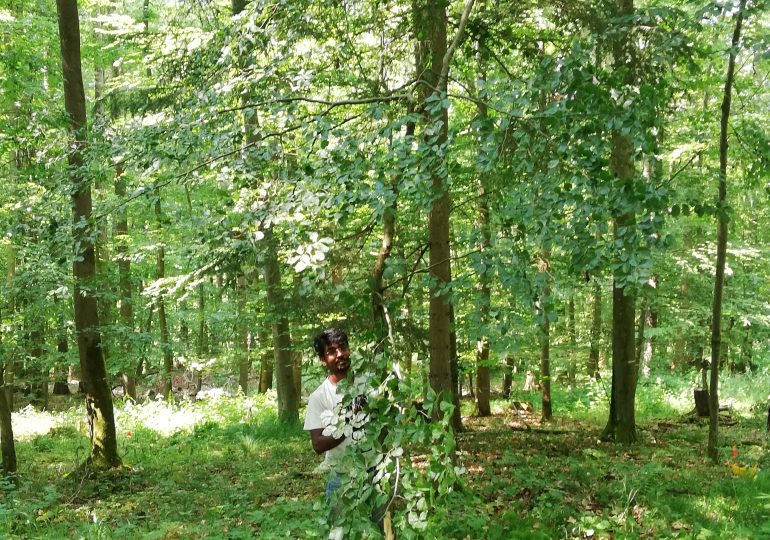
In this ‘Behind the Paper’ blog post, author Soumen Mallick – a Postdoctoral researcher at Field Station Fabrikschleichach, University of Würzburg – discusses the paper “Elevation reverses the effects of forest structure on folivory and leaf asymmetry“, which was recently published in Functional Ecology. Soumen shares how the team conducted large-scale forest experiments across Germany, the influence of climate on the impacts forest management actions, and the importance of collaboration and connection both within and outside of ecology.
About the paper
Forests across much of Europe have been shaped for centuries by timber production, often resulting in structurally uniform stands with limited variation in canopy openness and deadwood. In recent years, forest management and ecological restoration have increasingly sought to reverse this homogenization by creating canopy gaps and retaining deadwood to restore structural heterogeneity. These interventions are widely expected to benefit biodiversity and regeneration, yet their consequences for tree performance remain less clear. In our study, we addressed a simple but surprisingly unresolved question: does increasing forest structural heterogeneity help trees cope with herbivory and environmental stress, and does the answer depend on climate context, particularly elevation?
(Credit: Soumen Mallick)
To investigate this, we conducted a large-scale forest experiment across Germany that spans the elevational range of European beech. We examined two complementary indicators of tree condition: folivory, which reflects herbivore pressure, and leaf fluctuating asymmetry, a measure of developmental stability and physiological stress. In total, we analysed nearly 20,000 leaves from more than 1,400 trees across paired forests that were either structurally homogeneous or experimentally heterogenized. The main message of our study is striking: the same forest management intervention can have opposite ecological effects depending on the elevation. At low elevations, increasing structural heterogeneity reduced herbivory but increased developmental instability, whereas at high elevations the same intervention increased herbivory but improved developmental stability. This reversal demonstrates that forest structure does not operate in isolation; its ecological consequences depend fundamentally on background climate conditions. In other words, there is no single management strategy that works everywhere. Beyond our specific system, this finding highlights a broader principle: restoration and management strategies cannot be applied uniformly across landscapes. As climate change reshapes temperature and moisture regimes, understanding how structural interventions interact with macroclimate will be essential for maintaining forest resilience.
About the author
My interest in ecology began in childhood with a fascination for insects, especially butterflies. Learning about butterfly life cycles naturally led me to their caterpillar stage, and from there to the leaves they consume, gradually drawing me into the study of insect–plant interactions that remains central to my work today. I became involved in the BETA-FOR project during a visit to the Field Station Fabrikschleichach before formally joining the group, and although I participated in several ongoing projects, this one immediately aligned with my research interests. My current work focuses on tri trophic interactions among plants, herbivores, and predators, and on how habitat and host tree conditions shape insect performance and biodiversity patterns. More broadly, I am interested in integrating large multi taxon datasets to understand how biodiversity relates to ecological functioning and how ecological theory can inform forest management.
Outside research, I enjoy cooking for others, especially preparing Indian food, and sharing meals remains one of my favourite ways to connect with people. My scientific journey, however, has not always been straightforward. During my doctoral studies in France, I experienced a prolonged period of serious illness that forced me to step away from research for almost a year. After treatment in India, I was able to return to science with renewed perspective and determination. If I could offer advice to my younger self, it would be to pursue specialized training in ecology early, as entering ecological research from a broader biology background required learning much of the field while already conducting a PhD. Although challenging, that experience ultimately proved deeply rewarding.
Leave a comment