
As leaders gather in Santa Marta, Colombia to chart a course away from fossil fuels, the world is being reminded, again, of the cost of coal, oil and gas dependence.
We are in a fossil fuel crisis. The illegal invasion of Iran has brought suffering to millions across the Middle East and sent shockwaves through global energy markets, causing prices to surge around the world. In the Pacific, multiple countries have declared a state of emergency over potential fuel shortages and rising costs.
This week nearly 60 governments, along with hundreds of Indigenous peoples, civil society organisations, scientists and thousands of others from around the world, have gathered for the First Conference on Transitioning Away from Fossil Fuels. This landmark gathering could not be more timely. As our Head of Pacific, Shiva Gounden, who is on the ground in Santa Marta, explains:
This is our moment to choose a path of peace over a legacy of extraction, ensuring a safe and stable future for communities everywhere.
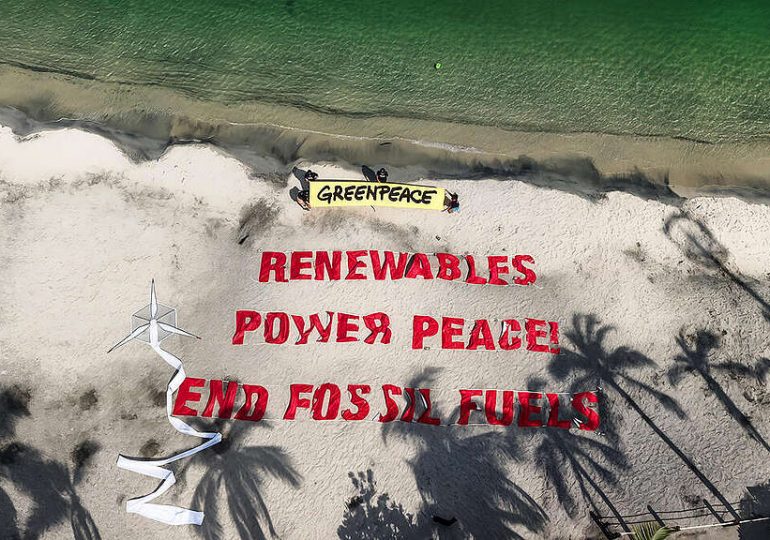
Greenpeace Colombia sends a message from the beaches of Santa Marta, during the First Conference on Transitioning Away from Fossil Fuels. © Sergio Calderón Cortés / Greenpeace
Fossil fuels are traded globally, but are controlled by a small number of states or corporations with the power to shape supply and price. When conflict erupts, when infrastructure is damaged, or when geopolitical tensions rise, the entire system shudders. The consequences are felt far beyond the point of conflict, landing hardest on households and communities.
Oil and gas corporations benefit from this instability and post enormous wartime profits, while families pay more for essentials like transport, food and energy. As our Head of Climate and Energy Joe Rafalowicz stressed last week when fronting a Senate inquiry into taxing gas:
Gas corporations like Woodside, Santos, Shell and Chevron …are making obscene war profits, using the illegal war on Iran to price gouge, profiteer and push for more gas we don’t need — while people and our environment pay the price.
Greenpeace Australia Pacific activists disrupted the Australian Domestic Gas Outlook conference in Sydney with the message ‘Gas execs profit, we pay the price’ © Greenpeace
This is happening in addition to the escalating toll of extreme weather disasters driven by the burning of coal, oil and gas, where communities are already paying for fossil fuel dependence through damaged homes and disrupted livelihoods. Now they are paying again through higher energy prices.
Why Santa Marta matters
This historic conference t is bringing together a broad coalition of countries ready to move beyond fossil fuels and can be a key turning point towards a clean energy future.
Pacific island countries have long been leaders in global climate action, championing the transition away from fossil fuels.
This shift is not just about cutting climate pollution. It is about building energy security and sovereignty through renewables — ensuring our energy systems are more affordable, locally owned and controlled, and resistant to geopolitical shocks.
Renewable energy is a game changer and the future will be increasingly powered by cheap, abundant clean energy, coupled with electrification. Wind and solar are produced locally, and do not rely on shipping routes that can be blocked. They are not priced on volatile global markets. And once built, they provide energy at predictable and increasingly low cost.
Electrification backed by renewables, reduces dependence on imported fuels, stabilises prices and strengthens energy sovereignty. In a world defined by uncertainty, that is not just a climate solution, but an economic and security strategy.
Communities in the Pacific and Australia urge government to end fossil fuels
In the lead-up to Santa Marta, campaigners and communities have been mobilising around the world to demand an end to fossil fuel dependence and a just transition to renewable energy.
The community in Mele, Vanuatu sent a positive message ahead of the First Conference on Transitioning Away from Fossil Fuels. © Sergio Calderón Cortés / Greenpeace
In Mele in Vanuatu, local community members sent leaders a message with the words “Renewables power peace! End fossil fuels”. Vanuatu, one of the most climate vulnerable nations of the world, has been at the forefront of global efforts to transition away from fossil.
In Sydney, staff from Greenpeace Australia Pacific echoed the message with a banner in front of the Opera House.
Greenpeace Australia Pacific sends a message of support and solidarity ahead of the First Conference on Transitioning Away from Fossil Fuels. Against the backdrop of the invasion of Iran and global fossil fuel crisis, the message highlights how moving from coal, oil and gas to renewable energy is the path to greater peace and stability in the world. © Greenpeace / Isabella Brown
These were just two of many actions across the globe with a singular message: fossil fuels are tied to conflict, volatility and rising costs. Renewable energy offers a path away from all three.
Governments in Santa Marta face a choice: They can continue dealing with the fallout of an extractive system punctuated by crises, or they can start phasing out fossil fuels in a fair, deliberate, funded and coordinated way.
Australia — one of the world’s largest fossil fuel exporters — will be among the countries represented in Santa Marta. Last November, Australia signed the Belém Declaration, recognising that limiting warming to 1.5C — a survival line for Pacific communities — means no new fossil fuels. Yet the Australian Government has continued to approve new coal and gas projects, and has no plans to phase down fossil fuel production. It is way past time for Australia to get with the program, and begin charting its own course beyond fossil fuels.
What governments must do to enable the transition
All countries must set timelines to end fossil fuel extraction and use, in line with their fair share of a global effort to limit warming to 1.5C. They must remove barriers to renewable energy deployment, avoid new frontiers of extractivism, and ensure the rights and voices of affected communities, countries and workers are at the heart of the transition.
It also means holding polluters to account. Coal, oil and gas corporations have profited from a system that drives climate breakdown and economic instability. The costs of that system should be borne by them, not by countries and communities already dealing with the impacts of climate change.
Santa Marta is not the end stage, but must be a catalyst towards an energy system that is more affordable, ends the age of extractivism, liberates us from dependence on volatile markets and supply chains, and stops imperilling all our futures through the impacts of climate change.
The alternative is tried and tested. Renewable energy systems are already delivering cheaper, more stable and more secure power in the countries that are investing in them.
The direction is clear. The only question is how quickly governments are prepared to move.
This is an edited version of a blog first posted by Martin Zavan for Greenpeace International.
Leave a comment