
In the last week of December, while most of the U.S. was still in holiday mode, Novo Nordisk’s plant in North Carolina was operating at full capacity.
On Dec. 22, the U.S. Food and Drug Administration (FDA) approved the company’s oral version of Wegovy, making it the first pill of the popular GLP-1 medications to get the green light for weight loss. People who want to lose weight and are prescribed Wegovy now have the option of taking the tablet daily, versus injecting themselves with the drug once a week. They’ll lose about the same amount of weight with either version: between 16% and 17% of their starting body weight.
[time-brightcove not-tgx=”true”]
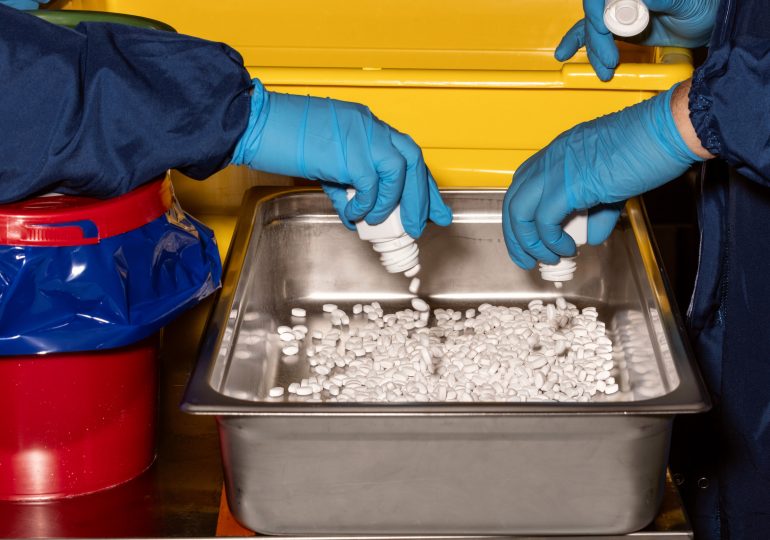
The plant, just outside of Raleigh, is operating around the clock to produce bottles of pills in four different doses. The bottles are bound for retail stores and online pharmacies and will be available starting on Jan. 5. “Obesity has become a consumer-oriented disease,” said Novo Nordisk’s CEO Mike Doustdar in an interview with TIME. “We’re embracing that.”
The company’s entire supply of the drug, from start to finish, will be manufactured in North Carolina. Days before the launch of Wegovy pill, TIME visited the plant to watch how the first Wegovy pills are being produced, bottled, and packaged for patients.
It all starts with yeast
Wegovy pill begins with a fungus: specifically, the same yeast used to make bread, called Saccharomyces cerevisiae. But instead of fermenting sugars or grains to make bread rise, the yeast cells are genetically engineered at Novo Nordisk’s facility in Clayton, North Carolina to produce a protein that undergoes fermentation in several four-story tall tanks, then multiple purification steps over about a month to produce semaglutide, a compound that mimics a human hormone that regulates appetite by working in the reward center of the brain. It can help people feel full and reduce feelings of hunger.
Harvesting the main ingredient
After the fermentation and purification process, semaglutide forms a beige paste with the consistency of pancake batter. In one of the few manual steps in the largely automated production, technicians scrape the paste from large funnels and freeze it at -20°C, where it keeps for up to five years. But given the popularity of Wegovy and the anticipated demand for the pill, the company currently has about a month’s supply of semaglutide in its freezers.
Taking pill form
In the final step of the process, the paste is thawed and purified into a liquid at a high temperature. That heated liquid is then spray-dried into a fine white powder, similar to the way snow-making machines turn hot water into snow. That powder, collected in large bags from a funnel that extends through three floors, is then pressed into Wegovy tablets.
A long path to the pill
While this semaglutide pill is the first to treat obesity, it isn’t the first that Novo Nordisk has made. The company’s scientists first became interested in semaglutide as a diabetes treatment since it can also help control blood glucose, and its first semaglutide-based therapy, Ozempic, was approved in 2017 for diabetes.
Patients injected themselves once a week to control blood sugar, but to make taking the drug easier, the company also developed a pill form, called Rybelsus, which the FDA approved in 2019. Turning Ozempic into an oral pill required finding a way to protect the drug from the hostile environment of the stomach just long enough for it to be absorbed by the body. “But with a lot of these strategies, it would cause too much permeability—so things that shouldn’t be absorbed, like bacteria or other things, were absorbed,” says Andrea Traina, senior medical director for obesity and liver health at Novo Nordisk.
The scientists ultimately found a way to create a chemical buffer to shield the drug while it released enough semaglutide to be effective. Still, because the pill has to go through the stomach and digestive tract, it’s generally not as effective as the injected Ozempic.
When diabetes patients noticed they were losing weight on semaglutide, Novo Nordisk and other companies began to study the compound for its potential effects on obesity. Studies confirmed what those patients were experiencing, and in 2021, the FDA approved Novo Nordisk’s Wegovy to treat obesity. But people still had to inject themselves with the medication to benefit from its effects.
Developing the Wegovy pill became the next challenge, and the same hurdles the company faced in developing Rybelsus remained. But this time, the researchers developed a proprietary fatty acid derivative to better navigate the difficult environment of the stomach. “After you swallow the tablet, it comes in contact with the stomach lining and starts to dissolve and create a foamy microenvironment around the pill,” says Traina. “Picture an Alka-Seltzer tablet dissolving in water.” The reaction temporarily inhibits stomach enzymes in the area from breaking down the drug, which gives the semaglutide enough time to be absorbed. “The whole process takes about half an hour,” she says, after which time “the microenvironment of the stomach goes back to normal.” To maximize the pill’s ability to absorb, people taking it should swallow it first thing in the morning on an empty stomach with up to half a glass of water with no food, drinks, or other medications for at least 30 minutes, the company advises, so nothing will interfere with the pill’s activity.
Stiff competition
Wegovy pill is not the only GLP-1 weight-loss pill on the horizon. Eli Lilly, which makes the injectable GLP-1 drugs Mounjaro for diabetes and Zepbound for weight loss (using the active ingredient tirzepatide) has developed a pill called orforglipron. In December, the company released positive data showing its pill could help people maintain weight loss after using injected forms of GLP-1 drugs for more than a year and submitted a request to the FDA for approval. The agency granted orforglipron a priority voucher in November, meaning the FDA will conduct an expedited review so that pill can come to market much faster than the typical drug.
Novo Nordisk and Eli Lilly have been locked in a GLP-1 competition for years. Some research has found that Lilly’s drug Zepbound leads to greater weight loss—up to 21% of body weight—compared to 15% on Wegovy. “The difference is very largely connected to doses,” says Doustdar; the highest dose tirzepatide is greater than that of semaglutide in Wegovy. For that reason, Novo Nordisk is developing a higher dose of Wegovy in the injectable form that produces comparable amounts of about 20% weight loss. “We will be bringing Wegovy-Plus into the market [in 2026] so it will close the gap with our competitor,” he says.
He also sees semaglutide as the company’s “secret sauce” that seems to produce a number of health benefits. It’s the only GLP-1 drug that the FDA allows to claim on its label benefits forthat heart disease and certain liver conditions benefit. While recent research found that the compound did not slow Alzheimer’s disease, as many had hoped it would, the drug’s ability to reduce inflammation could lead to additional health benefits in other metabolic diseases.
Doustdar, who was appointed to head Novo Nordisk last summer as the company began losing market share in the GLP-1 space to Eli Lilly, sees Wegovy pill as a coup for the company—and a return to focusing on diabetes and obesity. “This is a big disease area. We’re talking about two billion people, and eventually, someone has to produce all the doses for them. We are sitting in the right spot right now [to do that], and still only touching a fraction of the people who are in need.”
Options for the pill
In coming weeks, Wegovy pill will be available in four doses: a starter dose of 1.5 mg, as well as 4 mg, 9 mg, and 25 mg. As with injectable Wegovy, most patients will start with the lowest dose and gradually ramp up their dosage over a period of months until they reach the maximum dose, which they will continue to maintain their new weight.
As the company and the White House announced in November, the starter dose will cost $149 for a month’s supply for people paying out-of-pocket and using federal insurance plans. The next-highest dose will be $149 until April 2026, after which it will increase to $199 a month. The two highest doses will cost $299 for a month’s worth of pills. People with insurance plans that cover the pills may pay as little as $24 for a 30-day supply.
Doustdar says the White House announcement was the result of several months of discussion to reach a mutually agreeable price plan for the drug. “For us to be able to make any deals, it has to not be a zero-sum game, but a win-win situation,” he says. “We needed to explain that the cost of operations in the U.S. is very different from the cost of operations in Europe.”
“On the other hand, we also recognize that at higher prices, we will not get access to bigger volumes,” he says—and with hundreds of millions of people around the world who could potentially benefit from a weight-loss drug, Doustdar hopes Wegovy pill will be more convenient, and accessible, for them.
Leave a comment