
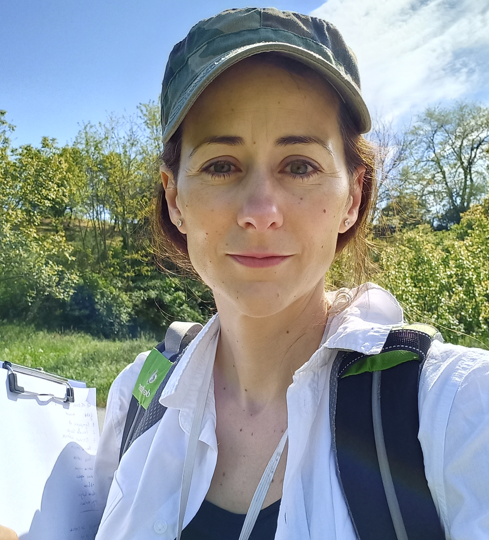
In this week’s ‘Behind the Paper’ blog post, author Dusanka Vujanovic discusses their new research article “Larval diet breadth and wingspan mediate landscape–richness relationship in butterfly communities“. Dusanka, a Research Associate at BioSense Institute, Serbia, examines what best explains variation in butterfly species richness across semi-natural grasslands: landscape structure, community trait composition, or their interaction. Dusanka focuses on whether landscapes shape not only how many butterfly species occur, but also which types of butterflies prevail.
1. About the Paper
What are you seeking to answer with your research?
We wanted to understand what really affects the number of butterfly species in a grassland. Is it mainly the surrounding landscape (how much of a certain habitat type there is, and how they are arranged in space), or does it also depend on butterfly traits such as wingspan and larval diet? More importantly, we asked whether landscapes affect all butterflies in the same way, or whether some types of butterflies benefit while others struggle. And finally, we wanted to know whether two places with the same number of species might still host very different kinds of butterfly communities.
What was the main take home message from your findings?
Our findings show that simply looking at the landscape structure does not tell us much about how many butterfly species live there. The picture becomes much clearer once we also consider how far they can fly and how picky their caterpillars are about food, i.e., how many plants they feed on. Larval diet breadth turned out to be the strongest predictor of species richness, independent of landscape structure. Grasslands dominated by butterflies whose caterpillars feed on fewer plants supported the most species, while communities dominated by butterflies that are extreme specialists or extreme generalists had fewer species. We also found that complex agricultural landscapes (areas with a patchwork of small fields, hedgerows, and semi-natural vegetation) can increase the number of butterfly species but those “extra” species tend to be similar in their traits, meaning communities become more trait-uniform. Habitat isolation told another important story. When grasslands were far from the nearest natural habitat, species richness increased only in communities dominated by large-winged butterflies. This shows that the ability to disperse determines which species can persist in isolated landscapes. Crucially, even when two sites had the same number of species, their trait composition could be very different.
What is the broader impact of the research? (outside of your specific species/study system)
Our results show that land-use change can maintain or even increase species counts while quietly filtering out certain trait types, for example, small-winged species or extreme dietary specialists. This means conservation cannot rely only on species numbers. It must also maintain connected habitat networks for weak fliers, and diverse host-plant resources for specialists. These insights are relevant to pollinator conservation and fragmented landscapes across Europe.
2. About the Research
What data did you collect and how did you collect it?
We surveyed butterflies at 50 semi-natural grasslands across Serbia over an entire season, from spring to autumn. We recorded over 7,500 butterflies belonging to 110 species. For each species, we compiled functional trait information related to wingspan size and resource use from database. We then combined field observations and trait data with satellite-based land-cover data.
Did you have any issues with data collection? If so, how did you resolve it and if not, what did you do to avoid potential issues?
We had a great time in the field, even though fieldwork always comes with its share of challenges, such as bee stings, ticks, and nights spent in remote and, let’s say, interesting locations. Weather was our biggest scheduling challenge since butterflies only fly under the right conditions. Beyond ecological challenges, there were also social ones. Interacting with local herders, shepherds, and residents in remote areas, where visitors are rare, proved that managing human dynamics can be just as demanding as facing physical field challenges. But, hey, it was all part of the adventure.
Were you surprised by any of your results?
Yes. Landscape variables alone explained almost none of the variation in species richness, while we expected habitat amount and connectivity to be stronger predictors. And then, dietary generalists did not support the highest richness as we expected. On the contrary, narrow diet breadth performed best, with richness declining toward both extremes.
What do you think is the next step for research on this topic?
The next step is to link these patterns to population stability and long-term persistence. For example, are butterfly communities with reduced variation in wingspan and larval diet breadth more vulnerable to future disturbances or environmental change? And do the same landscape–trait relationships hold in other regions?
Future research that combines trait-based approaches with long-term monitoring across multiple landscapes and climates will help answer these questions and guide more effective conservation planning.
3. About the Author
My interest in biology was sparked in childhood, watching David Attenborough documentaries with my father, which awakened enourmous curiosity. Growing up in mid- and post-war circumstances, further directed me toward the quiet and beauty of nature. I went on to study ecology, completing a PhD in plant ecology, and spent much of my academic training working in the field. Conducting research outdoors has always felt like a privilege.
Today, my research focuses on pollinators, with particular emphasis on identifying the key drivers of their decline and developing landscape-level conservation solutions. I am especially motivated to contribute to more environmentally and pollinator-friendly agricultural systems. Rather than repeating the familiar mantra that we must simply produce more food, despite Europe wasting over 80 million tonnes annually, I argue for smarter production: growing healthier, climate-resilient crops and encouraging more moderate consumption.
I’ve come to see the challenges researchers from the Balkans face as an advantage and a source of strength. Taking the harder route builds resilience and creativity, in a way – our own functional traits.
Outside of research, I enjoy spending time with my family, hiking, gardening, and more recently, writing animal-themed children’s books dedicated to my daughters.
Leave a comment