
2025 HALDANE PRIZE SHORTLIST: Kentaro Takagi discusses the paper “Realized flower constancy in bumble bees: Optimal foraging strategy balancing cognitive and travel costs and its possible consequences for floral diversity“, which has been shortlisted for Functional Ecology’s 2025 Haldane Prize for Early Career Researchers
About the Paper
Have you ever stopped to watch a pollinator moving among the blossoms? Interestingly, pollinators like bumble bees often show remarkable loyalty to a single flower species, even when other options are close by. This behaviour, known as “flower constancy”, benefits plants by reducing interspecific pollen transfer, which can lower reproductive success. The most common explanation for this loyalty is cognitive limitation: every time pollinators switch between flowers of distinct colours or shapes, they need to recall visual or motor memories from long-term storage. To save time, they simply stick to the last flower type they visited. This preference has led researchers to believe that flower constancy could drive greater diversity in floral phenotypes within plant communities. Yet, studies on flower colour patterns across communities haven’t consistently supported this idea.
In light of these inconsistencies, we began to wonder whether flower constancy observed in nature is really just a result of cognitive limitations. Alternatively, it may represent an adaptive strategy of pollinators, balancing the effort of recalling information with the travel costs incurred when moving between flowers of different species in natural environments. To test this idea, we conducted indoor experiments in which bumble bees foraged on two types of artificial flowers. We hypothesised that, when flower species are spatially mixed, bees that stick to one type waste time moving past nearby flowers. In these conditions, bees would reduce constancy, especially when the flower types look similar. As predicted, bees reduced their constancy as species mixing increased, with a steeper decline when colours were similar. These results suggest that flower constancy is a flexible, adaptive strategy in which bees balance cognitive and travel costs, and that species mixing can favour distinct flower traits among co-blooming plants.
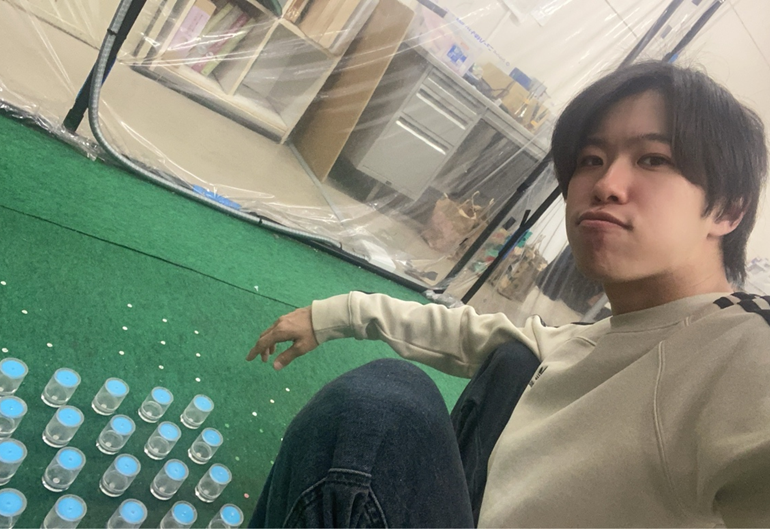
This study was my first publication as a first author, so the project was both challenging and deeply rewarding. One of the main challenges was justifying and designing the laboratory experiments. Although controlled settings allowed us to identify causal relationships, we constantly had to consider how our findings relate to behaviour in natural contexts. In addition, we had to set up everything ourselves, from experimental conditions to the bees’ experience. With the generous support of my supervisor, Dr Kazuharu Ohashi, I was able to bring the project to publication. I would like to express my sincere gratitude to everyone who supported me throughout this study.
About the author
I am currently in the final stage of my PhD in Japan and am about to complete my doctoral degree. During my undergraduate studies, I conducted research in plant molecular genetics. Over time, however, I became increasingly interested in broader evolutionary questions—specifically, how floral diversity evolves and how it is maintained in natural systems. This curiosity led me to pursue graduate studies in ecology. I now focus on pollinators’ cognition and behaviour, and I hope to continue exploring how plant–pollinator interactions shape floral trait diversity.
Read the full list of articles shortlisted for the 2024 Haldane Prize here.
Leave a comment