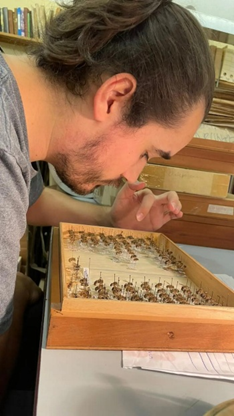
In this ‘Behind the Paper’ blog post, author Manuel López-Aliste discusses the paper “Differential effects of agricultural expansion on wild bee taxonomic and functional diversity“, which was recently published in Functional Ecology. Manuel discusses how agricultural expansion affects the variety of bee traits, using an entomological collection to measure functional traits, and the importance of trusting the process.
About the paper
Our paper focuses on how agricultural expansion affects both the taxonomic and functional diversity of wild bees in apple and sweet cherry orchards, in the context of central Chile, which is one of the global biodiversity hotspots for bees. Our results provide evidence that, as expected, taxonomic diversity is negatively affected by a lower proportion of surrounding natural areas. We also found, in certain cases, that a decrease in the percentage of natural area leads to functional homogenization. A novel approach we applied was to functionally differentiate between female and male bees, based on the fact that, in addition to having marked sexual dimorphisms, they also exhibit behavioral differences in terms of pollination.
About the research
Using pan traps, we collected bees within the crops for subsequent identification and quantification. Following identification, I had to visit biological collections — specifically the entomological collection at Universidad Metropolitana de Ciencias de la Educación (UMCE) and the native bee collection at Pontificia Universidad Católica de Valaparaíso (PUCV) — where we selected specimens from the bees collected in the field to measure functional traits. The main challenges we encountered were the lack of information on the biology of many of these bees, as well as the current absence of functional trait databases for them. It is worth mentioning that the large number of samples that needed to be processed was also a challenge. Something that surprised us in the results were the differences between male and female bee species in how they respond to the percentage of natural area. I believe that this approach — which seeks to account for a level of intraspecific variation such as sexual dimorphism — is key to advancing our understanding of how different functional traits are filtered by environmental pressures.
About the author
This research was my master’s thesis, and I am currently deciding where to continue my studies in order to advance my scientific career. Ecology has always been an area that has drawn my interest. I believe that functional diversity is a field where, although progress has been made, many questions and much work still remain. The ecology of Chile’s native bees also strikes me as a fascinating area of study, given the high levels of endemism and the complex evolutionary relationships that have developed. There will always be difficulties, of course, but I was fortunate to work with a very talented group of scientists who contributed in many ways to the completion of this work. Although I still consider myself a relatively young person, I think I would tell my younger self to trust the process a little more and not to doubt so much.
En Español
Nuestro paper trata sobre como la expansión agrícola afecta la diversidad tanto taxonómica como funcional de las abejas silvestres en plantaciones de manzana y cereza dulce. Esto en el contexto de Chile central el cual es uno de los “hotspots” de diversidad de abejas a nivel mundial. Encontramos en nuestros resultados evidencia de que como era de esperarse la diversidad taxonómica se ve afectada negativamente al haber menos proporción de áreas naturales circundantes, al igual que encontramos en ciertos casos que la disminución del porcentaje de área natural genera homogenización funcional. Un enfoque novedoso que aplicamos fue diferenciar funcionalmente a las hembras y los machos de las abejas, esto con el fundamento de que, junto con poseer dimorfismos sexuales marcados, también conductualmente tienen diferencias en cuanto a la polinización.
Mediante el uso de pantraps colectamos abejas dentro de los cultivos para su posterior identificación y cuantificación. Posterior a la identificación fue que tuve que ir a colecciones biológicas particularmente la colección entomológica de la Universidad Metropolitana de Ciencias de la Educación (UMCE) y la colección de abejas nativas de la Pontificia Universidad Católica de Valparaíso (PUCV) en donde elegimos especímenes de las abejas colectadas en terreno para hacer la medición de rasgos funcionales. Los principales problemas que encontramos son la falta de información respecto a la biología de muchas de estas abejas y también que no existen actualmente bases de datos con rasgos funcionales de estas abejas. Cabe mencionar que también la gran cantidad de muestras que hubo que procesar fue un desafío. Algo que nos sorprendió de los resultados fueron las diferencias entre machos y hembras de las especies de abejas en cuanto a como responden el porcentaje de área natural. Me parece que este enfoque que busca tomar en cuanta un nivel de diferencias intraespecíficas como el dimorfismo sexual son claves para lograr avanzar en el entendimiento de como los diferentes rasgos funcionales son filtrados por presiones ambientales.
Esta investigación fue mi tesis de magister y en este momento me encuentro eligiendo donde continuar mis estudios para avanzar en mi carrera científica. La ecología siempre fue un área que me ha llamado la atención. Me parece que la diversidad funcional es un área que, si bien se ha avanzado, aún quedan bastantes interrogantes y trabajo por hacer. También la ecología de las abejas nativas de Chile me parece super interesante de estudiar debido a los altos niveles de endemismo y las complejas relaciones evolutivas que se han dado. Obviamente siempre van a haber dificultades, pero tuve la suerte de trabajar con un muy buen grupo de científicos y científicas cuales aportaron de varias maneras a la realización de este trabajo. Si bien aún creo que me puedo identificar como una persona joven creo que le diría a mi versión mas joven que confíe un poco más en el proceso y no dude tanto.