In this ‘Behind the Paper’ blog post, author Mark Wong, a Forrest Fellow at the University of Western Australia, discusses his new article ‘Functional trait dissimilarity drives arboreal ant community assembly while competitive trait hierarchies shape colony performance in experimental mesocosms’. Mark delves into the world of ant community assembly, discusses how his team overcame unforeseen obstacles in the field, and how his childhood interest has led to a career in insect ecology.
1. About the Paper
How do species differences influence competition and structure local communities? Our new paper tackles this enduring question with rigorous field and experimental work in a unique model system: arboreal ants inhabiting naturally isolated and taxonomically identical trees within a small tropical mangrove.
These ant communities were perfect for revealing how competition shapes who lives where. The small spatial scale and low environmental heterogeneity over which they were distributed naturally kept other factors – like abiotic filtering and dispersal – out of the picture, letting the influence of competition come to the fore.
By sampling ants on 115 trees in the field, measuring traits spanning morphology, physiology, and diet, and running competition experiments in ‘bonsai’ mesocosms, we uncovered strong but context-dependent effects of trait differences on competitive outcomes and species co-occurrence.
In the field, we found clear evidence of limiting similarity – the classic signal of competitive assembly. Co-occurring ant species on trees differed significantly in morphological traits influencing how they find and capture food, such as the sizes of antennae, eyes and pronotums (‘shoulders’). This suggested that partitioning resource-acquisition strategies helped them avoid competitive exclusion and coexist.
Yet when we brought these species into close quarters in miniature ‘bonsai’ mangrove mesocosms with limited food, the pattern flipped. The traits that promoted coexistence in the field now drove directional competition: species with higher trait values suppressed those with lower values, reducing colony growth and survival over 30 days.
Together, these results highlight that species differences can shape competitive outcomes in opposite ways. They can promote coexistence by stabilising niche differences, or lead to exclusion via competitive hierarchies, with the predominance of either mechanism contingent on spatial scale and environmental context.
2. About the Research
The study took place in a small tropical mangrove in Hong Kong that I chanced upon while accompanying a friend on an unrelated project. As I broke twigs off the trees, I discovered ants nesting inside; some trees even housed up to four different species. Many trees stood neatly isolated by water, or by mud when the tide receded, and the ants never crossed between trees over either surface. Because all the trees were of the same species, similar in height (around 3–4 m), and easy to reach, I couldn’t shake the thought that this was the perfect place to study how competition shapes ant community assembly.
Surveying the ant communities of 115 trees was gruelling. We spent days knee-deep in hot mud, wading in slow motion from tree to tree, installing baits and capturing ants with the aid of a slippery ladder. The hardest part? There’s nowhere to sit and rest in a mangrove – you’ll soon sink under!
The field data allowed us to robustly characterise patterns of ant species co-occurrences at fine scale. With the specimens collected, we measured key traits in the lab, including morphological dimensions, thermal tolerances, and stable isotope ratios to infer trophic position. Putting these together analytically revealed a classical pattern of limiting trait similarity among co-occurring ant species in the mangrove.
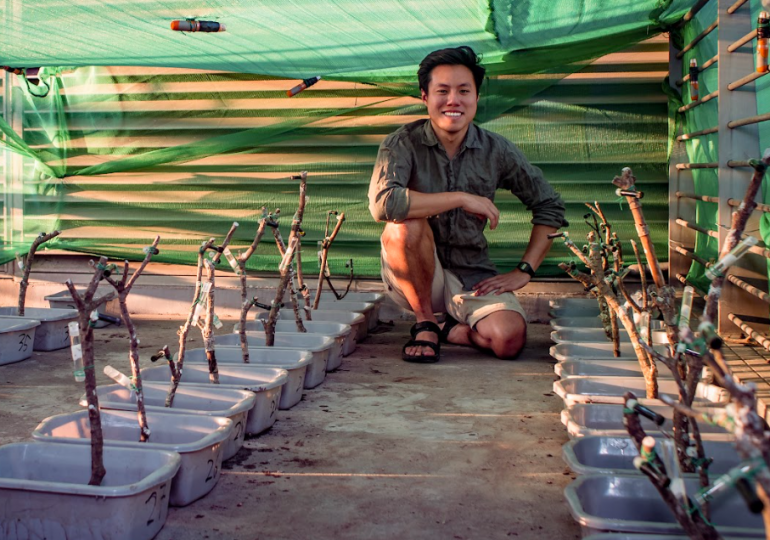
To experimentally test the effects of trait differences on competition, we collected colonies of multiple ant species from the mangrove and redeployed them into mesocosms, tracking the growth and survival of differently paired colonies over 30 days. We innovated the experimental setup: constructing miniature ‘bonsai’ mangroves by setting K. obovata branches in concrete and saltwater basins, designing arboreal nest tubes with sliding covers for observation, and preparing sugar and mealworm jellies to nourish the colonies.
We adapted to unforeseen obstacles. One early setback was the unexpected absence of queens from many colonies we collected. Rather than forgoing the experiment, we proceeded with colonies comprised of adult workers and larvae. To our delight, these kept functioning as the larvae effectively regulated key worker activities such as foraging and nest defence. Setting up the experiment was non-stop work: collecting hundreds of branches and twigs with ant nests from the mangrove, dismantling each by hand, aspirating ants, and transferring them to nest tubes (the trick is to place the larvae in the tubes so that the workers will follow).
I was initially surprised by the results from the experiment – strong competitive effects among ant species with dissimilar traits. This directly contrasted what I’d observed in the field. But I realised such hierarchical competition was consistent with the resource- and spatially limited nature of the mesocosms, which, compared to the actual mangrove trees, offered fewer available niches for species to differentially exploit.
I am pleased that this study not only infers but experimentally tests the effects of trait differences on the performance of competing ant colonies. And I hope it helps demonstrate and contextualise the opposing effects that trait differences can have competitive outcomes. The mangrove ants are a splendid model system and there are many other things I’d like to add to the mix – the effects of varying species densities, asymmetrical colony sizes, and behavioural syndromes to name a few. More broadly, the work has made me curious about when and how shifts between limiting similarity and hierarchical competition determine species and trait composition across animal communities.
3. About the Author
Flipping rocks searching for bugs was my favourite childhood activity so it was inevitable that I became an insect ecologist. Along the way I’ve been captivated by the extraordinary morphological and ecological diversity of ants and their sheer force on ecosystems. They inspire my research to examine global change impacts on biodiversity through a functional lens.
In 2026 I will start a new lab, Sydney Functional Ecology, as an Australian Research Council DECRA Fellow and Lecturer at The University of Sydney. We shall leverage functional trait approaches to tackle pressing biodiversity challenges, especially at the intersection of biological invasions and urbanisation.
Author Information:
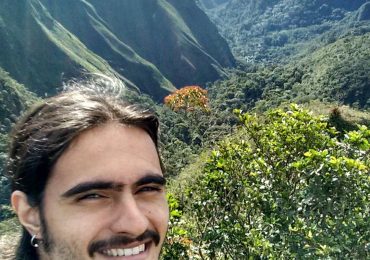
Dr Mark Wong (He/Him)
X: @markklwong | BlueSky: markklwong.bsky.social
Leave a comment