
This month, thanks to your generosity, ACE has awarded $1,897,538 from our Recommended Charity Fund to our Recommended Charities. This is the second largest amount disbursed since launching the fund in 2017, and a $60,000 increase over last February’s distribution. We are eager to see the positive change these charities can accomplish for farmed and wild animals over the next six months with this funding.
Last August, ACE’s Recommended Charity Fund awarded $821,224 to our Recommended Charities. Those organizations shared how they used their grants to make a positive impact on animals, and we’re thrilled to share their achievements with you. Please enjoy the highlights below, made possible with your support. Thank you!
Discover what ACE’s Recommended Charities have accomplished for animals in the second half of 2025 with support from the Recommended Charity Fund.
Aquatic Life Institute
$90,192 grant
Aquatic Life Institute (ALI) continued to utilize donor support to transform food systems and protect aquatic animals, as guided by its impact measurement framework: Recognition, Protection, and Prioritization.
Recognition – Is aquatic animal welfare seen as relevant, legitimate, and urgent?
ALI consolidated its role as a trusted expert within EU governance through sustained participation in three European Commission Advisory Councils, contributing to the EU Code of Good Practices on Fish Welfare, which explicitly cites ALI’s scientific work on stunning and slaughter.
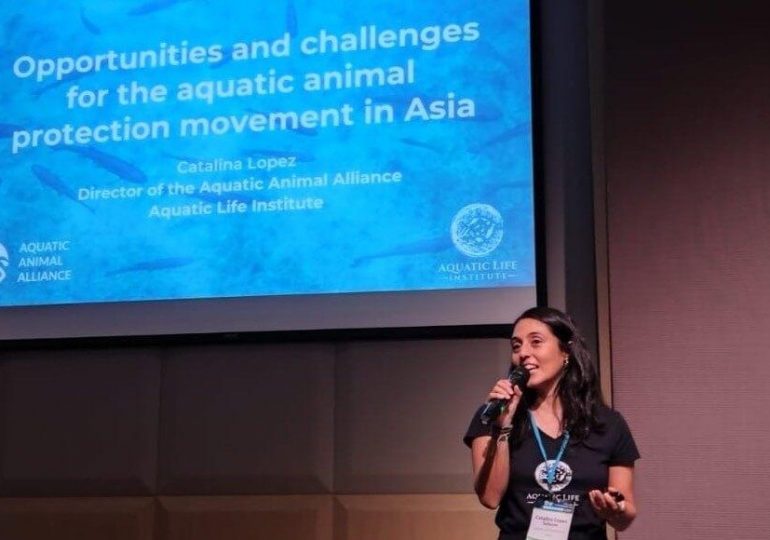
ALI delivered the first-ever aquatic animal welfare session at the Asia for Animals Conference, elevating aquatic animals within the regional animal protection agenda and strengthening the Aquatic Animal Alliance’s coordination role.
ALI reframed sustainability narratives within the seafood industry through a feature in Feed & Additive Magazine, reaching decision-makers representing an estimated 62% of the global aquafeed market and positioning animal welfare as a core sustainability consideration.
Protection – Are commitments and regulations being adopted to protect aquatic animals?
ALI released the 2025 Aquaculture Certification Schemes Benchmark, introducing new welfare criteria on transport and genetic modification and driving competition among certifiers to strengthen standards impacting tens of billions of animals annually.
Sustained engagement informed a landmark commitment by the Global Seafood Alliance to eliminate eyestalk ablation in BAP-certified shrimp farming by 2030, with potential benefits for 44 billion shrimp per year.
ALI advanced the Ban Octopus Farming Campaign, supporting new legislative action in Chile, coordinated coalition pressure in Mexico, and continued momentum across the U.S.
Prioritization – Is aquatic animal welfare embedded in long-term decision-making?
ALI advanced welfare considerations within UN Ocean Conference (UNOC) processes, contributed to COP-level climate and food systems dialogues, and strengthened regional coordination mechanisms shaping long-term seafood governance.
In 2025, ALI strengthened its organizational foundations to support stable, accountable, and effective delivery across a growing global team. Read the full Year End Report here.
Çiftlik Hayvanlarını Koruma Derneği
$80,698 grant
Kafessiz Türkiye conducted four visits to cage-free producers in Türkiye. The goals of these visits are to observe the living conditions of animals and assess the scale of cage-free production capacity in Türkiye.
ASLI reported implementing their transition to cage-free eggs.
Future For Fish organised a research project to assess the effectiveness of electrical stunning machines used by aquaculture companies in Türkiye.
Kafessiz Türkiye renewed its social media profile and website after redesigning its communications strategy. This new approach has enabled their Instagram account to steadily grow 0.5% every week.
Dansk Vegetarisk Forening
$104,433 grant
Dansk Vegetarisk Forening (DVF) held the international policy summit, Plant Food Summit, in collaboration with the Danish Government and the EU Presidency, on October 20-21, 2025. 425 stakeholders from 38 countries participated, including 75+ government officials representing 24 EU member states, as well as 40+ representatives from farmers’ associations. There are signs the summit has inspired subsequent political action in several countries, including governments inviting national stakeholders to submit proposals for national action plans. Based on the success, DVF is now considering a global policy summit in 2028.
During Denmark’s EU Presidency, DVF organized participation of Danish key stakeholders at multiple events across Europe under the initiative Danish Plant-Based Diplomacy, which is supported by several farmers’ associations and other mainstream stakeholders. This included events at embassies in France and Spain, as well as other events in Finland, Ireland, Hungary, France, Italy and Spain. It also included co-organizing a delegation of 15 stakeholders from Poland visiting Denmark.
DVF was an official partner at Denmark’s Pavilion at COP30. In total, DVF organized or co-organized 10 events at COP30 (with participation of ministers from Denmark, Brazil and Ghana), while also appearing in seven events organized by others, and distributing a large number of hard copies of Denmark’s plant-based policies, including to several ministers and high-level officials. Six weeks before COP30, DVF hosted an event at the Danish Embassy in Brasilia, which was attended by 12 government officials from Brazil, and a civil society roundtable with 25 Brazilian stakeholders.
To diversify income sources, DVF invested in fundraising and thereby increased the annual value of recurring small-donor donations by an additional $50,000 USD, while increasing their number of email contacts from 18,000 to 30,000 by creating a health-focused newsletter. This will ensure future growth in small-donor donations, while also educating and inspiring thousands of people.
Faunalytics
$37,976 grant
Faunalytics completed the following research studies, analyses, and data visualizations in the second half of 2025.
Quantifying The Small Body Problem: A Meta-Analysis Of Animal Product Reduction Interventions
Political Animals? How U.S. Voters Respond To Candidates Making Farmed Animal Policy Proposals
Public Acceptability Of Standard U.S. Animal Agriculture Practices
Aquaculture Fundamentals, a comprehensive, single-page resource that gives you a rundown on the major issues involved with aquaculture.
The 4th Annual Research Symposium, Fauna Connections, welcomed 459 attendees from 61 countries, and session recordings have received over 518,000 views on YouTube.
Tactics In Practice: Additional series covering The Impact Of Vegan Documentary And Video and The Science Of Making And Keeping Veg*ns.
Additionally, throughout the year, over 90 advocates and organizations were assisted with free one-on-one support through Faunalytics’ Office Hours program, where they help advocates find and apply data to their campaigns. They also published over 250 articles, summarizing external studies on important topics in animal advocacy. Read on to view their full 2025 Year In Review and 2026 Plans.
Good Food Fund
$47,470 grant
Best-Practice Casebook
As part of its fifth annual case collection program, the Good Food China Action Hub curated 18 rigorously reviewed best-practice case reports and compiled them into a professionally designed, visually accessible casebook, supporting knowledge sharing and cross-sector learning.
Selected Hand-Drawn Poster Exhibition
Selected first- and second-prize winning posters from the “Exploring Eastern Plant-Based Diets” national hand-drawn poster competition were professionally exhibited at the Good Food Summit, with a dedicated display area that amplified youth voices and generated strong engagement from conference participants.
Award-Winning Poster Collection Book
Winning posters were curated into a professionally designed bilingual (Chinese–English) collection; the book was showcased at the Good Food Summit and the World Food Forum, receiving strong and positive audience engagement.
Institutional Catering Engagement
Completed case studies of three domestic and four international universities.
A roundtable during the Good Food Summit identified the distinct priorities and challenges of university dining directors, researchers, and contract caterers. In-depth discussions laid groundwork for future collaboration.
Engagement with WHO Asia-Pacific Centre for Environment and Health (ACE)
Under WHO ACE’s new Strategic Plan, GFF is collaborating closely to co-develop its China implementation program, acting as a key connector. A workshop was convened in Beijing in October, bringing together diverse institutions and experts.
GFF is leading a baseline assessment on school meals within the program. Next steps include mapping the current landscape, policy and training systems, and good practices, in deep collaboration with Chinese CDC to identify high-impact leverage points.
Developing a China-specific EAT-Lancet Report
Co-initiated by GFF and Prof. Pan An (2025 EAT-Lancet Commissioner) in late 2025, this research project will deliver an overall assessment and a China-specific reference diet.
An advisory committee is formed, including top level experts.
Active engagement underway with EAT and The Lancet to target publication by 2028.
Legal Impact for Chickens
$61,710 grant
Victory! On September 11, 2025, the California Court of Appeal summarily denied defendant Alexandre’s writ petition in the animal-cruelty case Legal Impact for Chickens v. Alexandre. This appellate-court decision essentially upholds the Humboldt County Superior Court’s ruling that Legal Impact for Chickens has the power, as a California society for the prevention of cruelty to animals (SPCA), to prevent cruelty through civil litigation. The animal-cruelty case against Alexandre Family Farm will thus continue. The case has since returned to Humboldt County Superior Court to determine whether Alexandre illegally neglects and abuses its cattle. And the parties have begun discovery, a legal process where each can demand and receive information from the other.
On August 21st, 2025, Legal Impact for Chickens represented a Tyson shareholder in filing a Delaware Code section 220 lawsuit in the Delaware Court of Chancery. The complaint demands that Tyson allow LIC’s client to view records documenting the company’s treatment of workers and animals. Tyson turned over some records to the shareholder. The Court of Chancery then held a trial on December 9, 2025 on whether Tyson must produce additional records.
Legal Impact for Chickens released a PSA starring Oscar-nominated actor James Cromwell and former poultry grower Craig Watts urging chicken-industry workers to speak out about animal abuse and neglect.
New Roots Institute
$42,723 grant
Between August 2025 and January 2026, New Roots Institute advanced cost-effective, scalable strategies to reduce factory farming by building leadership capacity and securing institutional change across food systems, policy, and education.
Leadership Pipeline
New Roots welcomed 100+ fellows from 21 U.S. states and 12 countries through our Summer Leadership Academy, with many continuing into the Academic Year Fellowship. Fellows developed campaign, policy, and movement-building skills focused on high-leverage interventions.
Academic Year Fellowship
During the fall, fellows launched nearly 50 campaigns targeting tractable opportunities for systemic change. As they continue their work this spring, notable initial outcomes include:
Institutional procurement reform: A Forward Food Pledge secured at Pomona College, committing to more sustainable food purchasing policies.
Behavioral defaults: An oat milk default pilot launched at the University of British Columbia to reduce animal product consumption using evidence-based nudges.
Education as pipeline building: Creation of a new for-credit course at Haverford College on transforming global food systems.
Movement integration: Fellows and alumni represented New Roots at Effective Altruism Summits in Berlin, Los Angeles, Vancouver, and Nigeria.
Policy career capital: Fellows secured placements in climate and food-adjacent policy roles, including a Climate Finance Policy Internship at the U.S. Climate Alliance.
Alumni Outcomes
As of early 2026, New Roots alumni are contributing to reducing factory farming across 100+ organizations in 200+ roles, totaling 150,000+ hours of impact. Recent highlights include:
Elimination of plant-based milk upcharges at UC San Diego dining.
Appointment of an alum as a Youth Climate Commissioner for Los Angeles County.
Contracts with UC Berkeley and the University of Michigan to reduce animal products by 10% in year one, for a 50% reduction commitment over 5 years.
Together, these outcomes reflect New Roots’ focus on scalable institutional change, evidence-based interventions, and long-term talent development in neglected yet high-impact cause areas.
Shrimp Welfare Project
$71,204 grant
Scaling Proven Solutions
Shrimp Welfare Project supported the shrimp farming industry in its transition to humane slaughter by signing 9 new memorandums of understanding (MOUs) with producers and seafood suppliers, bringing the total to 30. Once all stunners are delivered and operational, their Humane Slaughter Initiative will be helping about 5.4 billion shrimps per year.
Retailer momentum is growing in Europe, with Dutch retailer Jumbo and French retailer Les Mousquetaires recently publishing shrimp welfare policies. In total, 11 major supermarkets across the UK and Europe have committed to humane slaughter and eyestalk ablation-free supply chains.
Shrimp Welfare Project provided hands-on implementation support to help ensure that corporate commitments translate into practical solutions on farms by assisting with commissioning, training, and improving protocols for stunning equipment. They are currently hiring for two Technical Field Coordinators based in Latin America and Asia, respectively.
Sustainable Shrimp Farming in India (SSFI) expanded its sludge removal programme to nearly 200 acres, improving pond conditions and reducing chronic suffering in India’s top shrimp-producing region.
Strengthening the Evidence Base
Shrimp Welfare Project continued catalyzing research projects intended to reduce key uncertainties and improve best-practice guidance for humane slaughter, including academic studies and technical development efforts.
The organisation also continued building its monitoring, learning, and evaluation work, including releasing its first Corporate Impact Metrics report for 2025.
Growing the Shrimp Welfare Ecosystem
Shrimp welfare reached new audiences through impactful outreach including a feature story in Vox and an industry-facing Q&A published in trade outlet Shrimp Insights.
Shrimp Welfare Project met with key stakeholders at shrimp industry conferences including the Catch Welfare Platform Conference and the Global Shrimp Forum — where Chief Programmes Officer Krzysztof Wojtas spoke on a panel about shrimp welfare. The team also met in-person for “Shrimposium,” their annual strategy retreat.
Sinergia Animal
$94,939 grant
Sinergia Animal recently published its 2025 report. Read more about our year here.
Following the 11 commitments secured in the first half of the year, Sinergia Animal secured 12 additional corporate commitments between August and December, bringing the total to 23 new commitments in 2025 to phase out cruel confinement systems such as battery cages and gestation crates across Southeast Asia and Latin America.
The Nourishing Tomorrow program significantly expanded its reach in the second semester, adding 24 new institutional diet-change commitments (up from the initial agreements in Argentina), bringing the total to over 2.6 million plant-based meals annually across 168 locations.
The organization published the fifth edition of the Cage-Free Tracker, an essential accountability tool that monitors 110 companies in Latin America and Southeast Asia, revealing that 66% of the companies evaluated are already reporting progress on their welfare pledges.
Sinergia Animal released a high-impact undercover investigation exposing extreme animal cruelty at a major egg supplier to Productos Ramo, one of Colombia’s largest food companies. The footage revealed birds in overcrowded battery cages and sparked a massive public campaign to hold the company accountable for failing to meet higher welfare standards.
Following a 2024 joint investigation by Sinergia Animal and We Animals Media exposing severe animal welfare and public health risks at the Cañuelas Cattle Market, SENASA, Argentina’s National Service for Agrifood Health and Quality, announced it will launch new animal welfare guidelines and protocols for the market. This regulatory step closely followed Sinergia Animal’s formal letter urging stricter rules, oversight, and enforcement.
The Humane League
$85,445 grant
In the second half of 2025, The Humane League (THL) was laser-focused on holding companies accountable for sparing hens from suffering. Thanks to their work, 46 companies including Best Western, Pret A Manger, and 7-Eleven reported progress on their commitments to spare 82.8 million hens from cages. Based on the progress these companies made, THL estimates they spared 2.5 million hens from cages.
In the US, THL led a fierce campaign against Subway, the largest restaurant chain in North America. As a result, Subway fulfilled its cage-free promise, sparing more than 340,000 hens annually. And THL continued to pressure Ahold Delhaize, a major retail conglomerate, to uphold its cage-free commitment. For five weeks, THL staff, Changemakers, and coalition partners protested at the headquarters of Ahold Delhaize subsidiaries Stop & Shop in Quincy, MA and Food Lion in Salisbury, NC to ensure decision-makers felt the heat.
The OWA’s annual Cage-free Fulfillment Report found that as of July 2025, 92% of all cage-free commitments due in 2024 or earlier have been fulfilled. This is up from 89% in 2024, and confirms a trend: thanks to the work of THL and coalition partners, companies continue to fulfill their cage-free commitments at high rates, and even those that miss their initial deadlines may fulfill them in subsequent years with sustained pressure.
The Open Wing Alliance held its Global Summit in Warsaw, Poland in September. More than 100 activists from 39 countries convened to network, learn from each other, and take bold action to end the abuse of chickens.
THL’s public policy experts fought back against efforts to overturn state protections for farmed animals, from federal courts to state legislatures. And they grew the Animal Policy Alliance to 31 members in 21 states, winning key local policy victories for animals.
Wild Animal Initiative
$104,433 grant
Wild Animal Initiative became formally represented by Strategy Director Mal Graham on the Roundtable on Science and Welfare of Animals Involved in Research, housed within the National Academies’ ‘Board on Animal Health Sciences, Conservation, and Research (BAHSCR). Mal will continue in this role for at least one year.
Presented at High-Impact Conferences
Technology in Wildlife Welfare, offering wildlife professionals, academics and technology experts an opportunity to explore technologies that monitor and improve wild animal welfare.
Ecological Society of America Annual Meeting (ESA), presenting on the importance and impact of validations in wild animal welfare science.
International Society of Wildlife Endocrinology, presenting on the intersection between endocrinology and welfare.
Animal Welfare Research Network 9th Annual Meeting, co-organized a section on novel research in wild animal welfare science.
Priority topics: welfare indicator validation, interspecific interactions, population dynamics, juvenile welfare, and invertebrate and fish welfare.
Grantees published research addressing critical welfare questions, including measuring oxytocin in feces and ethical use of animal-borne devices in post-release monitoring.
Key Research Projects
In-house field study on house sparrows, completing fieldwork banding 28 birds and conducting experiments across five sites, collecting over 50 hours of video and 25 hours of audio. Now analyzing data to validate behavioral welfare indicators.
Published Considering affective state as a central component of the response of animals to environmental changes, exploring how affective states may contribute to determining how animals respond to environmental changes through phenotypic plasticity, environmental modification or dispersal.
Published Bye-bye bycatch: a remotely closing trap for targeted songbird capture, introducing a trap design that reduces bycatch and improves research efficiency and animal welfare.
Published Research sense: Incorporating animals’ sensory capacities in animal care and study design, providing methodologies for institutional review committees to evaluate sensory considerations in research proposals.
We hope that you are inspired by these achievements!
If you want to fuel more positive progress for neglected animals, please support ACE’s Recommended Charity Fund and share this update with a friend. Your action today will help reduce animal suffering tomorrow. Thank you!